Best B2B Prospecting Software in 2026: 10 Tools Compared and Who Each One Is For
We compared 10 B2B prospecting tools in August 2026 and ran one live query across four of them. See what each costs and what they actually returned.
Start with one question: do you need more contacts, or better timing? For contact volume, Apollo.io gives you data and email sending in one seat. For timing, Agent Jesse finds companies showing buying signals right now. For custom data workflows, Clay lets your ops team chain providers together. This page compares all ten.
How we evaluated these tools
We checked every tool on eight things:
- Prospecting method — database, live search, signals, workflows, or intent
- Data freshness — how current the records are
- Contact coverage — emails, phone numbers, and how deep the data goes
- Ease of use — whether one person can run it without help
- Pricing transparency — whether you can work out the cost without a sales call
- Free plan — whether you can test it before paying
- Best-fit use case — the job it does better than the others
- Limitations — where it falls short
Anything we could read from a vendor page, we read on 20 August 2026. Each tool lists its own sources so you can check us. We also ran one live query across four of the tools, below. It is one query, not a benchmark, so we still do not publish a score.
This is not a ranking. The tools are listed in no order of quality. A tool near the bottom of this page may be the right one for your team. Read the "Use it if" line before anything else.
We ran the same query across four tools
Most comparison pages summarise vendor marketing. We ran one real query instead, on the same day, and kept the screenshots.
The query. "Find me my next customers — BFSIs facing challenges with debt recovery."
We typed it into Agent Jesse, Apollo.io, Lusha and Clay on 21 August 2026, using each tool's own AI or chat interface. It is a hard query on purpose. "BFSI" is an industry. "Facing challenges with debt recovery" is not — it is a condition you can only detect from recent filings, earnings and news.
Head-to-head prospecting test, 21 August 2026. One query, four tools, same day.
| Tool | Results returned | How it read the query | Evidence attached to each result |
|---|---|---|---|
| Agent Jesse | 99 companies | Industry plus the debt-recovery condition | Dated rationale and a named source on every row |
| Apollo.io | 726 companies | Industry plus “AI buying signals” | None. The AI research step returned an error |
| Clay | 1,435,405 results | Industry only, via 15 sector filters | None at preview stage |
| Lusha | 327,590 results | Applied one filter: Building Construction | None |
Only one of the four returned companies with a reason attached. The other three returned broad lists with no evidence on the row.
Agent Jesse — 99 companies, each with a dated source
Every row carried a source and a dated explanation for why the company was included.
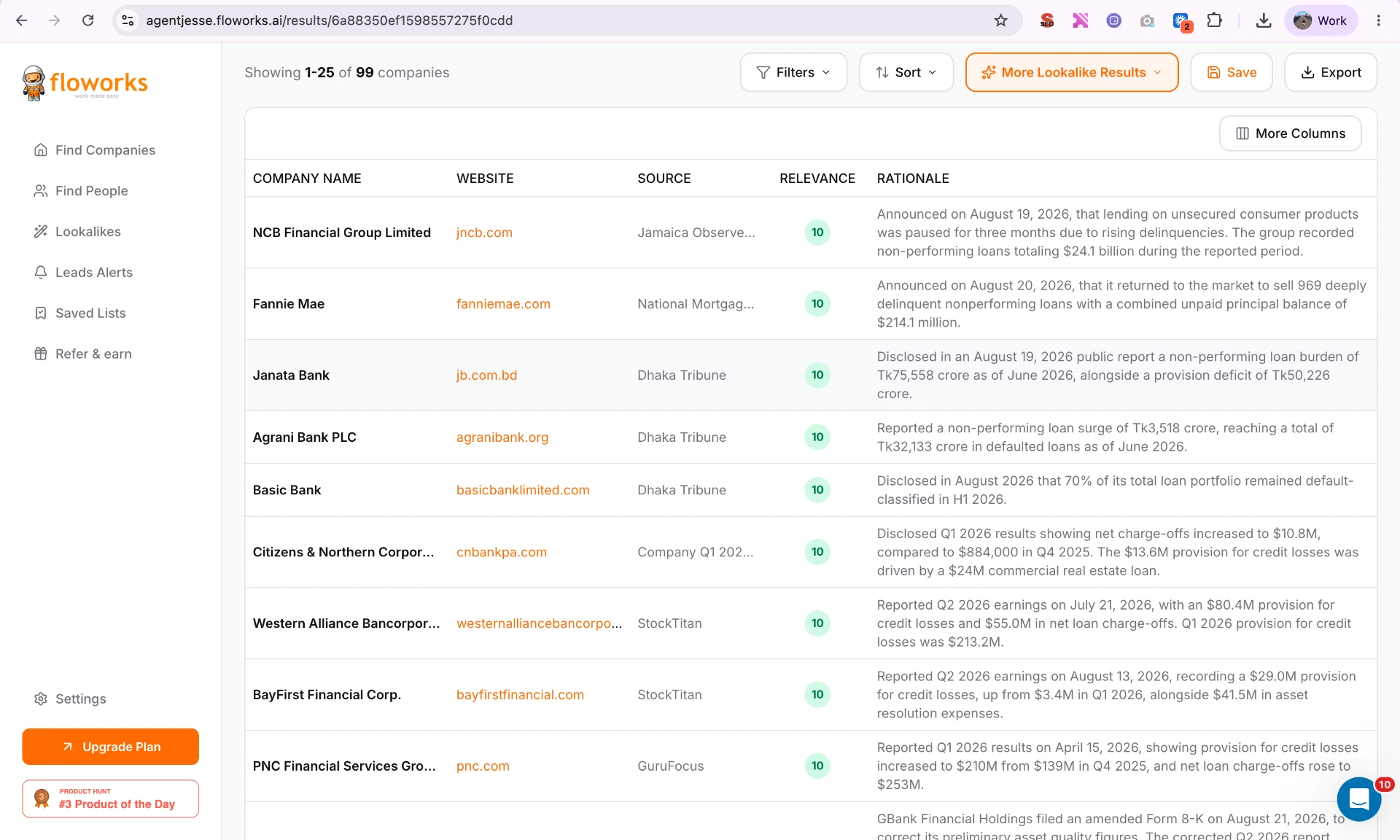
- NCB Financial Group — paused lending on unsecured consumer products for three months on 19 August 2026, after rising delinquencies. It recorded $24.1 billion in non-performing loans. Source: Jamaica Observer.
- Fannie Mae — returned to market on 20 August 2026 to sell 969 deeply delinquent non-performing loans worth $214.1 million. Source: National Mortgage News.
- BayFirst Financial — Q2 2026 earnings on 13 August 2026 recorded a $29.0M provision for credit losses, up from $3.4M in Q1. Asset resolution expenses were $41.5M. Source: StockTitan.
Honest caveats. Agent Jesse returned 99 companies, not the 100 asked for. The list spans Jamaica, Bangladesh, the US and elsewhere, because the query set no geography. If you need US-only, you have to say so.
Apollo.io — 726 companies, and the AI step failed
Apollo returned 726 BFSI companies tagged with AI buying signals. When we asked it to check which of them actually had debt-recovery problems, the research step failed:
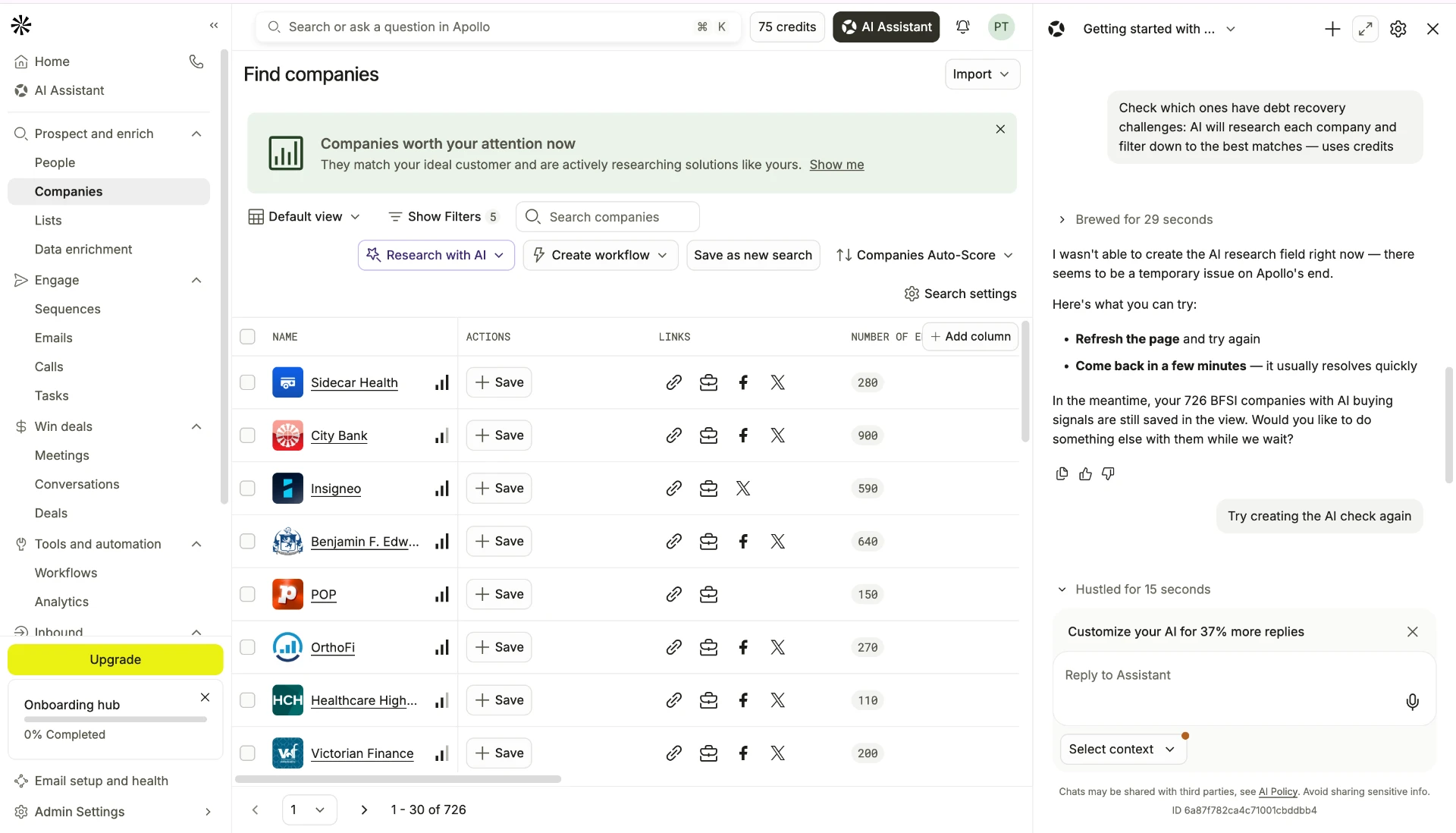
"I wasn't able to create the AI research field right now — there seems to be a temporary issue on Apollo's end."
Be fair to Apollo here. This was a platform error on the day, not a missing feature. Apollo has the capability and it did not run for us. What we can report is the list we were left with. The visible results included Sidecar Health, OrthoFi and Healthcare Highways. Those are healthcare businesses, not BFSI. Without the research step, the list was an industry filter.
Clay — the right industry, no signal filter at preview
Clay understood the sector properly. It built 15 industry filters — banking, financial services, insurance, capital markets, credit intermediation, loan brokers and more — and returned 1,435,405 results. Its assistant also proposed exactly the right enrichments: recent legal collection activity, firms hiring for collections roles, and news about non-performing loan portfolios.
But at preview stage the list was JPMorganChase, Goldman Sachs, Citi, HSBC, Morgan Stanley and Wells Fargo. The largest banks in the world, not banks with a debt-recovery problem.
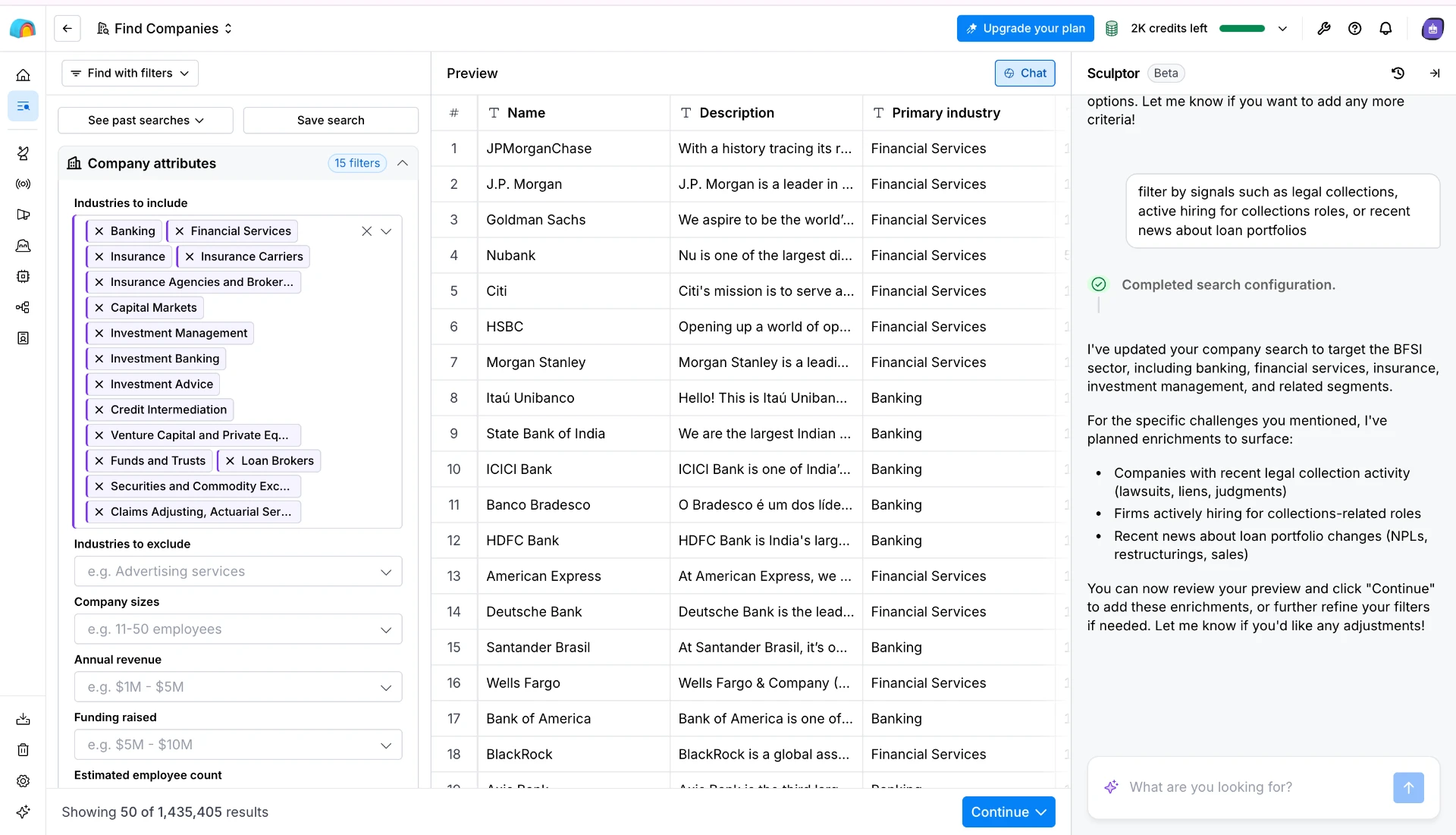
Be fair to Clay too. The enrichments were planned, not yet applied. Applying them takes more steps and more credits, and would likely have improved the list. That is the trade Clay makes: more control, more work.
Lusha — we could not get a relevant list
Lusha's assistant reported that it had searched using one filter: Industry: Building Construction. It returned 327,590 results, led by Larsen & Toubro, Skanska, Bechtel, Holcim, Turner & Townsend, Hilti and Lennar.
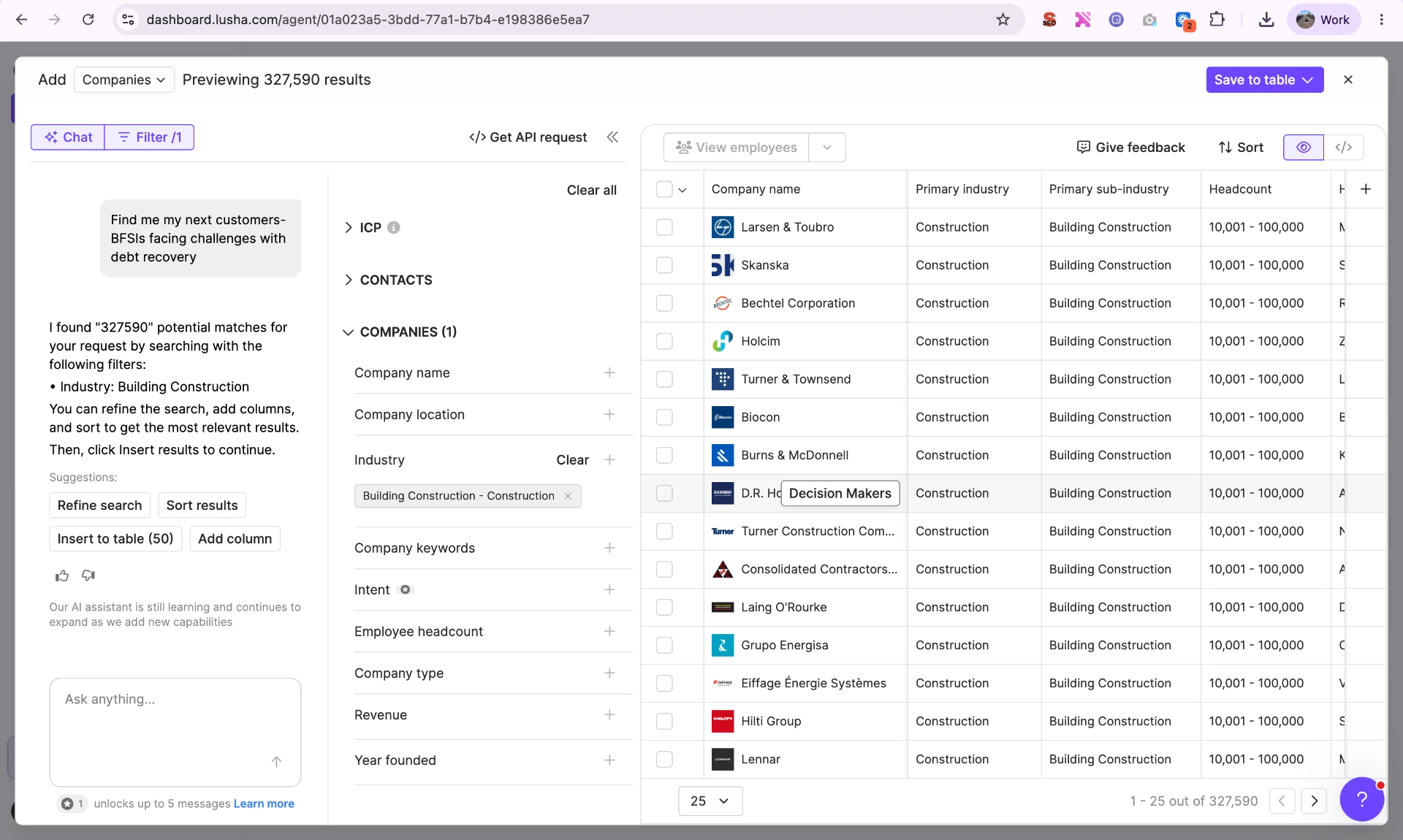
We took the assistant's first answer and did not refine it further. Lusha also offers manual filters alongside the chat, and a differently worded prompt may well work better than ours. What we can say is narrow: on this query, in this interface, on this day, we could not get a list that matched the brief.
What this test does and does not show
What it shows. On a condition-based query, the tool built for live search returned evidence and the database tools returned industry lists. That matches how each is built and is the clearest demonstration of the coverage-versus-timing split on this page.
What it does not show. This is one query, on one day, run by the Agent Jesse team — and we make one of the tools. Apollo's AI step failed for platform reasons and deserves a rerun. Clay's enrichments were never applied. We did not test ZoomInfo, Cognism, 6sense, RocketReach or Ocean.io. All of them need a sales conversation or a paid seat we did not have.
What we would need for a stronger claim. Three queries rather than one, including a plain firmographic search that databases should win. Blind scoring by someone outside Floworks. And a rerun of Apollo once its research field works. We plan to publish that. Until then, treat this as one worked example, not a benchmark.
The 10 best B2B prospecting software tools compared
Prices read from each vendor's public pricing page on 20 August 2026.
| Tool | Best for | Search method | Entry price (Aug 2026) | Free plan | Price published |
|---|---|---|---|---|---|
| Agent Jesse | Buying signals, now | Plain-English query | Free; from $9/mo | Yes, one-time | Yes |
| Apollo.io | All-in-one + sending | Filters | $49/user/mo annual | Yes | Yes |
| Clay | Custom data steps | Workflow builder | From $54/mo annual | Yes | Yes |
| Sales Navigator | Warm introductions | LinkedIn filters | $79.99/user/mo annual | No | 2 of 3 tiers |
| ZoomInfo | Large-company org charts | Filters | Quote only | Yes, Lite | No |
| Cognism | UK and EU phone numbers | Filters | Quote only | No | No |
| 6sense | Prioritising target accounts | Predictive model | Quote only | Yes | No |
| Lusha | Shared seats and credits | Browser extension | $49.90/mo | Yes | 4 of 5 tiers |
| RocketReach | Looking up more than you download | Lookup | $69/user/mo | Yes | Yes |
| Ocean.io | Finding lookalike companies | Company similarity | $47.25/mo annual | Trial | Yes |
Four of the ten charge for what you use: Agent Jesse, Clay, Ocean.io, and Lusha. The other six charge per seat, so your bill grows as you hire. Three publish no price at all — ZoomInfo, Cognism, and 6sense.
Disclosure: Agent Jesse is made by Floworks. It appears on this page, checked against the same eight points as every other tool.
The 10 tools
Each tool below is split in two. What we verified is read from the vendor's own pages, with the date we checked. Our take is our opinion, and you should weigh it as such.
Agent Jesse — best for finding companies showing buying signals right now
What we verified
- Price — Free; Pro $9, Business $29, Max $100 per month. Annual billing saves 22%.
- Free plan — Yes. 1,000 credits, given once rather than monthly.
- Main features — Live people and company search, saved lists, daily alerts. CSV export, lookalike search and email or phone enrichment from Pro. API, MCP server and n8n access from Business.
- Credit model — Search costs 10 credits, email 5, phone 30 with the email included. Pro includes 1,000 credits a month, Business 8,000, Max 30,000.
Sources: Agent Jesse Pricing · Checked 20 August 2026
Our take
- Use it if — timing matters more to you than job titles, or you are entering a market you do not know yet.
- Good at — describing a buyer in a sentence and getting companies that changed something recently.
- Avoid if — you want a dialer or email sending in the same tool. Also skip it if you need deep org charts inside very large companies, or your work is phone-heavy. At 30 credits a number, this is the most expensive phone enrichment of the ten.
Apollo.io — best for all-in-one prospecting and sending on one budget
What we verified
- Price — Free; Basic $49, Professional $79, Organization $119 per user a month on annual billing. Monthly billing is $59, $99 and $149.
- Free plan — Yes, free forever.
- Main features — Contact database plus multi-step sequences, calls, LinkedIn tasks and a meeting scheduler in one subscription.
- Credit model — One shared credit pool. Extra credits can be bought at any time.
Sources: Apollo.io Pricing · Apollo Sequencing · Checked 20 August 2026. Apollo's price table loads in the browser, so the figures above are cross-checked against two dated third-party sources.
Our take
- Use it if — you want data and email sending on one invoice, and your buyer is easy to describe with filters.
- Good at — consolidating three or four subscriptions into one seat price.
- Avoid if — your work depends on accurate direct dials. Third-party reviews report weaker phone accuracy than Cognism and put phone reveals at 8 credits against 1 for an email. We could not confirm either figure in Apollo's own documentation.
Clay — best for teams that want to build their own data steps
What we verified
- Price — Free; Launch from $54 a month, Growth from $185 a month on annual billing. Enterprise is custom. Clay does not charge per user.
- Free plan — Yes. 500 actions and 100 data credits a month, unlimited seats, 200 rows per table.
- Main features — Waterfall enrichment across many providers, tried in a fixed order, billed only for the one that returns a confident result.
- Credit model — Two meters: actions and data credits. Data credits start at $0.05. Extra credits on Launch and Growth carry a 30% premium.
Sources: Clay Pricing · Clay Waterfall Enrichment · Checked 20 August 2026
Our take
- Use it if — someone on your team owns data operations as their actual job.
- Good at — sitting on top of Apollo or ZoomInfo and paying only for the provider that answers.
- Avoid if — nobody owns it. Clay resells other providers' data rather than holding its own. So the bill moves with usage, and it is harder to predict than a per-seat fee. The learning curve is real.
LinkedIn Sales Navigator — best for selling through warm introductions
What we verified
- Price — Core $99.99 a month, or $959.88 a year, which works out at $79.99 a month. Advanced $179.99 a month, or $1,679.88 a year. Advanced Plus is quote only.
- Free plan — Not published on the plan comparison page.
- Main features — Search and filtering on LinkedIn's own member data, saved-lead alerts, InMail, CSV upload and CRM import.
- Credit model — 50 InMail credits a month on all three tiers. No data-export credits.
Sources: Sales Navigator Plan Comparison · Checked 20 August 2026
Our take
- Use it if — your pipeline comes from introductions and you already pay for a data tool.
- Good at — profile changes such as a new job title, which appear as members update them. In our assessment that beats a web crawl for this one signal.
- Avoid if — you expect it to replace a data tool. Sales Navigator does not surface email addresses or phone numbers, and it is not built for bulk contact export.
ZoomInfo — best for large companies that need org charts and compliance
What we verified
- Price — Quote only. ZoomInfo publishes no figure for any paid tier.
- Free plan — Yes. ZoomInfo Lite gives 10 credits a month, no card required.
- Main features — Contact and company data, buying-intent data, website de-anonymisation and call recording. Org charts show reporting structure and stakeholder relationships, on the Elite plan.
- Credit model — Consumption based. One credit per profile or company export. The cost per credit is not published.
Sources: ZoomInfo Pricing · ZoomInfo Org Charts · Checked 20 August 2026
Our take
- Use it if — you sell into very large organisations and need contracts your procurement team will approve.
- Good at — org charts and account intelligence in big accounts. Based on our evaluation it was the strongest option here for that job.
- Avoid if — you need to know the price this quarter. Platform fees stack on seat fees, and you cannot work out total cost without a sales cycle.
Cognism — best for cold calling in the UK and Europe
What we verified
- Price — Quote only. Two published tiers, Standard and Pro, each including 5 seats.
- Free plan — None, and no self-serve trial.
- Main features — Phone data screened against do-not-call registers in 12 countries, including the UK's TPS and CTPS. Data processed under legitimate interest. ISO 27001, ISO 27701 and SOC 2 Type II.
- Credit model — One credit reveals one contact. Viewing a contact you already revealed costs nothing.
Sources: Cognism Pricing · Cognism Compliance · Checked 20 August 2026
Our take
- Use it if — you cold call into the UK or Europe and need a defensible compliance position.
- Good at — European phone data. We did not find equivalent do-not-call screening documented by the other nine tools.
- Avoid if — you sell mainly in the US, or you are a small team. In our assessment US coverage trails ZoomInfo, and the five-seat minimum rules out solo sellers.
6sense — best for large teams choosing which accounts to work first
What we verified
- Price — Quote only. No figure published. Vendr's purchase data across 381 deals puts the typical contract at $62,440 a year.
- Free plan — A free Sales Intelligence plan exists, but 6sense does not publish its credit allowance.
- Main features — Predictive model that identifies accounts already in market using intent signals and buying-stage predictions, plus dashboards and a sales copilot.
- Credit model — Data credits unlock and export emails, phone numbers and enriched records. The cost per credit is not published.
Sources: 6sense Pricing · 6sense Account Identification · Vendr 6sense Data · Checked 20 August 2026
Our take
- Use it if — you run account-based marketing against a large fixed account list, with someone to operate the model.
- Good at — telling you which 50 of 5,000 accounts to work this quarter. You are buying prioritisation, not a contact list.
- Avoid if — you have fewer than about 50 reps. The entry point is built for enterprise budgets.
Lusha — best for small teams sharing one pool of credits
What we verified
- Price — Free; Starter $49.90, Pro $69.90, Premium $399.90 a month. Scale is quote only. Lusha prices per plan, not per user.
- Free plan — Yes. 40 credits a month, one seat.
- Main features — Browser-extension contact lookup. Pro includes 2 seats and Premium 5, expandable to 10 and 25, all drawing on one credit pool.
- Credit model — An email costs 1 credit. Lusha's documentation and its pricing FAQ disagree on phone numbers, giving 5 credits and 10 credits. Monthly plans roll credits forward up to twice the allowance. Annual plans do not roll over at all.
Sources: Lusha Pricing · Lusha Credits & Billing · Checked 20 August 2026
Our take
- Use it if — you are a small team that already knows the target accounts and wants shared seats.
- Good at — one line item for several reps, where most of the others here charge per person.
- Avoid if — you are buying annual and ramping slowly. Unused yearly credits expire, and phone numbers cost several times what an email does.
RocketReach — best for people who look up more contacts than they download
What we verified
- Price — Free; Essentials $69, Pro $119, Ultimate $209 per user a month on monthly billing. Custom team plans start at $6,000 a year for teams of five or more.
- Free plan — Yes. Five one-time lookups, email only.
- Main features — Contact lookup and export, CSV enrichment, integrations and API.
- Credit model — Two separate meters, lookups and exports. A premium lookup returns email and phone for the same single credit. Annual plans give unmetered lookups under a fair-use cap and a limited yearly export allowance.
Sources: RocketReach Pricing · Checked 20 August 2026. Annual-billing rates move with promotions and are not reported here.
Our take
- Use it if — you qualify far more contacts than you actually download. Recruiters and researchers fit this shape.
- Good at — research-heavy work where a phone number costs no more than an email.
- Avoid if — you need volume into a CRM. Exports are metered separately, and the entry plan allows about 100 a month.
Ocean.io — best for finding companies that look like your best customers
What we verified
- Price — $0.063 per credit with a 9,000 credit minimum, shown as $47.25 a month, billed yearly at $567. Unlimited seats included.
- Free plan — A trial exists, but Ocean.io does not publish its length or allowance.
- Main features — Company similarity search that finds lookalikes of your best customers.
- Credit model — A verified email costs 1 credit, a direct phone 10, a search result 0.2. Exports are free.
Sources: Ocean.io Pricing · Checked 20 August 2026
Our take
- Use it if — you have a large team and your ideal customer is easier to show by example than describe with filters.
- Good at — cost that scales with data rather than headcount. It was the only tool here publishing an explicit price per credit.
- Avoid if — your outbound is call-led or your team is small. The 9,000 credit floor buys only 900 phone numbers.
What we would buy, by budget
No single tool does everything. Most teams end up running two. Here is how we would spend, by budget.
- Under $100 a month. Start with Apollo.io's free plan for contact volume. Add Agent Jesse Pro at $9 to catch buyers earlier. Add a cheap email tool when Apollo's free sending runs out.
- $100 to $500 a month. Make Apollo.io your base at $49 per user. It covers contacts and email in one place. Add Agent Jesse Business at $29 when reply rates stall. Add Clay only if someone owns data operations.
- Cold calling in Europe. Buy Cognism first, whatever else you run. It is the only tool here that documents do-not-call screening across 12 countries. Agent Jesse will not solve this problem.
- Enterprise budget. Start with ZoomInfo or 6sense. You are paying for org charts, approved contracts, and account ranking. Add Agent Jesse only if reps want signals the ranking misses.
- Starting from zero today. In order: Apollo.io free plan, Agent Jesse Pro at $9, an email tool, then Clay. Leave ZoomInfo and 6sense until someone asks you for a contract.
Frequently asked questions
Which prospecting tool should I actually buy first?
Start with the free plans. Apollo.io's free tier shows you whether filters describe your buyer well. Agent Jesse's free plan shows you whether timing is your real problem. Most teams find out inside a week. Then buy the paid version of whichever one you kept opening. Do not buy two tools before you know which problem you have.
I'm the only salesperson at my company. What do I need?
Two things: something to find people, and something to email them. Agent Jesse at $9 a month or Apollo.io at $49 per user covers the finding. Apollo.io includes email sending, so it can cover both. Skip Clay, ZoomInfo, and 6sense for now. All three assume someone else runs them for you.
How much does ZoomInfo actually cost?
ZoomInfo does not publish prices. Neither does Cognism or 6sense. You have to book a call and get a quote. Reported contracts vary so widely that no honest single number exists. Third-party purchase data puts Cognism's typical yearly contract at $36,000 and 6sense's at $62,440. Expect a platform fee on top of per-seat fees.
Is Apollo worth paying for, or is Sales Navigator enough?
They do different jobs. Sales Navigator tells you who someone is and when they change roles. It gives you no email addresses or phone numbers, and you cannot export lists. Apollo.io gives you the contact details and sends the emails. If you can only afford one, Apollo.io is the more complete tool.
What's the cheapest way to find leads if I have no budget?
Use the free plans. Clay gives you 500 actions a month with unlimited seats. Agent Jesse's free plan is 1,000 credits, given once rather than monthly. Apollo.io, Lusha, and RocketReach have free tiers too. Below that, tracking funding news, job postings, and company announcements by hand costs nothing but time. It works. It just will not scale past a few hours a week.
Why do the emails on my lead list keep bouncing?
Your list is probably older than it looks. Databases copy contact details once, then refresh on a schedule. People change jobs constantly, so records go stale between refreshes. Vendors update popular industries often and leave the rest. If you sell into an unusual niche, expect your worst bounce rates there.
How do I find companies that just raised money and are hiring?
Name three things: the type of company, the event, and the location or size. For example, software companies in Texas that raised a Series A and are hiring sales reps. Agent Jesse takes that as a plain sentence. In a filter-based tool you build the same thing from funding and job-posting filters.
Can I just scrape LinkedIn instead of paying for any of this?
You can, but it breaks LinkedIn's terms of service and can get your account restricted. Scraped profiles also give you no verified email or phone number, so you still need a data tool afterwards. Sales Navigator is the sanctioned way to use LinkedIn data, at $79.99 per user a month.
Is it legal to cold call companies in the UK and Europe?
Business-to-business calling is generally allowed, but the rules are strict. You must screen numbers against do-not-call registers, and GDPR requires a lawful reason to hold someone's data. Cognism screens do-not-call lists across 12 countries, which is why teams calling into Europe buy it. Check with your own legal advisor before you start.
Prices read from vendor pages on 20 August 2026. Apollo.io and Lusha were checked against two dated sources.
Find your next 100 customers with Agent Jesse
Live-internet prospecting, free to start. No credit card required.